Simmer
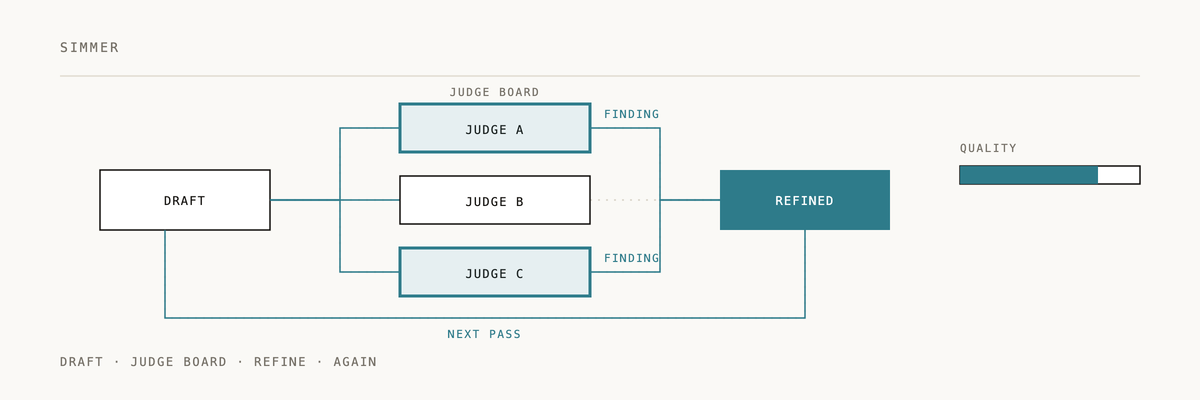
You wrote a prompt. It works. But is it good? Simmer runs your artifact through multiple rounds of criteria-driven refinement — each round, a panel of judges reads your code, understands the problem, and proposes specific improvements.
Read the story behind Simmer →
Iterative artifact refinement — take any artifact or workspace and hone it over multiple rounds using criteria-driven feedback.
Installation
/plugin marketplace add 2389-research/claude-plugins
/plugin install simmer@2389-research
What This Plugin Provides
One skill (simmer) with four subskills that run the refinement loop:
- Setup — identify the artifact (file or workspace), elicit 2-3 quality criteria, determine evaluation method
- Generator — produce an improved version based on the judge's ASI (Actionable Side Information — the single highest-leverage fix)
- Judge — score the candidate 1-10 per criterion, produce the ASI
- Reflect — record the trajectory, track the best candidate across iterations
Trigger Phrases
Say any of these to start a simmer loop:
"simmer this", "refine this", "hone this", "iterate on this", "make this better", "improve this over a few rounds", "polish this", "tighten this up", "optimize this pipeline", "find the best model for this task", "tune this configuration"
Any request to iteratively improve an artifact triggers simmer.
When to Use Simmer vs. Cookoff vs. Omakase-Off
| Situation | Use | Why |
|---|---|---|
| You have an artifact and want it better | simmer | Iterative refinement against criteria |
| You want parallel code implementations competing | cookoff | Parallel generation + fixed criteria + pick winner |
| You don't know what you want yet | omakase-off | Parallel designs + react + discover preference |
Rule of thumb: Simmer = serial iteration. Cookoff/omakase-off = parallel exploration.
Quick Example: Single File
User: "Simmer this" [pastes a pitch email]

Claude: I'm using the simmer skill to set up iterative refinement.

What does "better" mean for this? I'd suggest:
1. Value prop clarity
2. Tone match
3. Call to action strength

User: "Those work"

[Iteration 0: Judge scores seed — 4.0/10]
[Iteration 1: Generator fixes value prop → 5.3/10]
[Iteration 2: Generator fixes CTA → 6.3/10]
[Iteration 3: Generator fixes tone → 7.3/10]

Trajectory:
| Iter | Value Prop | Tone | CTA | Composite | Key Change |
|------|-----------|------|-----|-----------|------------|
| 0    | 4         | 5    | 3   | 4.0       | seed       |
| 1    | 7         | 5    | 4   | 5.3       | specific problem statement |
| 2    | 7         | 6    | 6   | 6.3       | low-friction CTA |
| 3    | 7         | 7    | 8   | 7.3       | peer-sharing tone |

Best candidate: iteration 3 (7.3/10)
3 iterations complete. Run 3 more?
Quick Example: Workspace with Evaluator
User: "Simmer this pipeline — find the best setup for this task"

Claude inspects the workspace, finds evaluate.sh and config.json,
and proposes criteria + evaluation method:

  Evaluator: ./evaluate.sh
  Criteria: accuracy, cost efficiency, latency
  Search space: models, prompt text, pipeline topology

User: "Looks good, coverage is the priority. 5 iterations."

[Iteration 0: Run evaluator on seed, judge scores — 3.7/10]
[Iteration 1: Generator swaps to cheaper model → 5.3/10]
[Iteration 2: Generator splits into 2-step chain → 7.0/10]
[Iteration 3: Generator adds few-shot examples → 7.7/10]
...

Best candidate: iteration 4 (8.1/10)
Works On Anything
| Artifact type | Suggested criteria |
|---|---|
| Document / spec | clarity, completeness, actionability |
| Creative writing | narrative tension, specificity, voice consistency |
| Email / comms | value prop clarity, tone match, call to action strength |
| Prompt / instructions | instruction precision, output predictability, edge case coverage |
| API design | contract completeness, developer ergonomics, consistency |
| Pipeline / workflow | coverage, efficiency, noise |
| Configuration / infra | correctness, resource efficiency, maintainability |
Evaluation Modes
| Mode | When to use |
|---|---|
| Judge-only (default) | Text artifacts — judge scores against criteria |
| Runnable | Code/pipelines — judge interprets script output |
| Hybrid | Both — run script AND judge results against criteria |
No format contract on evaluator output. The judge reads whatever your script produces — test results, metrics, error logs, anything.
Judge Board
Simmer auto-selects between a single judge and a multi-judge board based on complexity:
- Simple (short email, tweet, ≤2 criteria) → single judge, fast
- Complex (3 criteria, long artifact, code, pipelines) → judge board with deliberation
The board constructs three judges tailored to your specific problem — not from a fixed menu, but by reading your artifact, criteria, and constraints and designing judges with diverse perspectives. An extraction prompt gets different judges than a DND adventure hook.
Judges investigate before scoring — they read the evaluator script, ground truth, prior candidates, and config files to understand the problem deeply. A judge who reads the evaluator discovers scoring mechanics on iteration 0 instead of learning them through 3 iterations of trial and error.
If a single-judge run hits a plateau (3 iterations without improvement), simmer offers to upgrade to the board mid-run with 2 extra iterations.
Defaults and Safety
Default iteration count: 3 rounds per batch. After each batch, simmer asks whether to continue. You can request a specific count ("simmer this for 10 rounds") or stop early at any prompt.
Regression safety: The reflect subskill tracks the best candidate seen so far. If a new iteration scores lower than the current best, the best-so-far is preserved — the loop never loses progress. At the end, result.md always contains the highest-scoring candidate, not just the latest one.
Advanced Features
| Feature | When you need it |
|---|---|
| Workspace targets | Refining a multi-file directory — iterations tracked as git commits so you can diff any two rounds |
| Runnable evaluators | Your artifact has a test script — point simmer at it (python evaluate.py) and the judge interprets output |
| Background constraints | The generator needs to know what's available (models, budget, latency targets) to make realistic choices |
| Output contracts | Valid output has a defined shape (e.g., JSON schema) — violations score 1/10, forcing format fixes first |
| Validation commands | A cheap pre-check (./validate.sh) catches broken pipelines in seconds before the full evaluator runs |
| Search space tracking | Explicit bounds on what to explore — reflect tracks tried vs. untried regions so the judge steers toward gaps |
See the v2 design spec for full details on each feature.
Output Directory Structure
Single-file mode (default output dir: docs/simmer):
docs/simmer/
  iteration-0-candidate.md     # Seed (original artifact)
  iteration-1-candidate.md     # Each improved candidate
  iteration-2-candidate.md
  iteration-3-candidate.md
  trajectory.md                # Running score table
  result.md                    # Final best candidate (highest score, not necessarily latest)
Workspace mode:
./pipeline/                    # Target directory (modified in place)
  [project files]              # Tracked via git commits per iteration

docs/simmer/                   # Tracking files (separate from workspace)
  trajectory.md                # Running score table
Workspace iterations are tracked as git commits rather than separate files.
How It Works
- Focused improvement — each iteration targets one direction (the ASI), not everything at once. Compound gains over scattered edits.
- Context isolation — generator doesn't see scores, judge doesn't see previous scores. Each role gets only the context it needs to avoid bias.
- The generator is the search strategy — in workspace mode, the generator decides what to change (swap a model, restructure a pipeline, tune a prompt). The ASI guides direction, the generator executes.
See the design spec for the full architecture.
Related Skills
Part of the test-kitchen family, but independently installable:
test-kitchen:omakase-off— parallel design explorationtest-kitchen:cookoff— parallel implementation competitionsimmer— iterative refinement
Documentation
- CLAUDE.md — full plugin instructions
- Simmer skill — orchestrator
- v2 Design — design spec
- Integration tests — test scenarios
If Simmer helped you ship something better than your first draft, a ⭐ helps us know it's landing.
Built by 2389 · Part of the Claude Code plugin marketplace